I Torment, Therefore I Am!
On the Neurosis of Internet Censorship
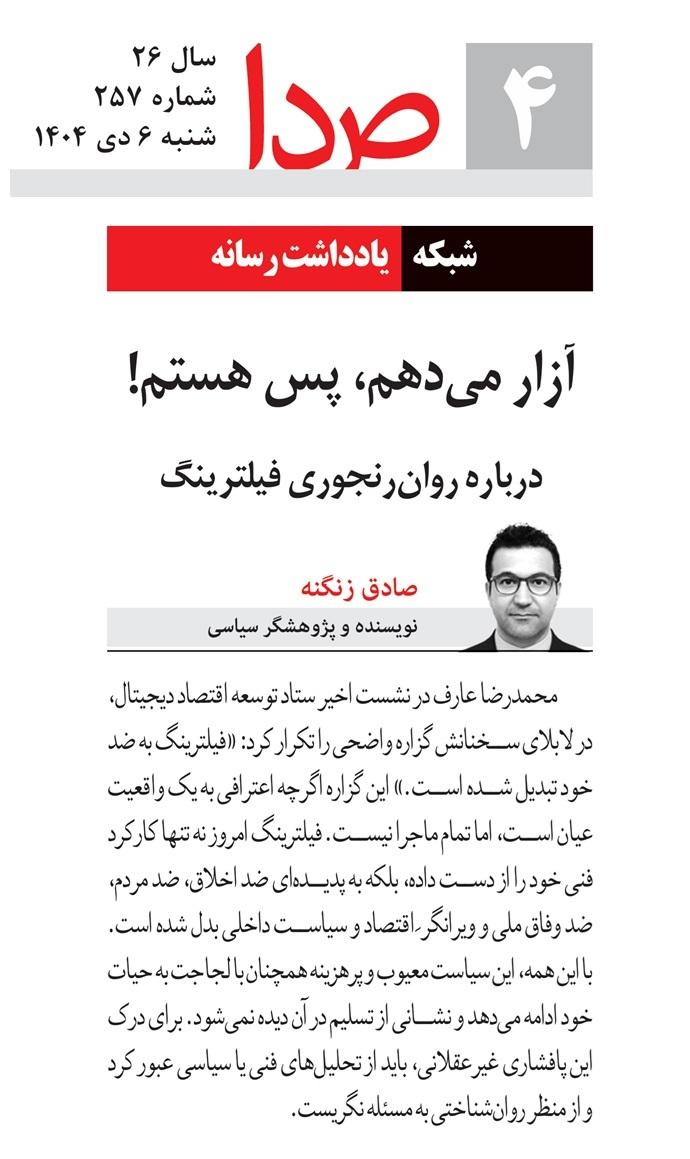
During a recent meeting of the Digital Economy Development Task Force, First Vice President Mohammad Reza Aref reiterated a glaringly obvious truth: "Internet filtering has turned into its own antithesis." While an honest confession, this statement captures only part of the story. Today, internet censorship has not merely lost all technical efficacy; it has transformed into an anti-ethical, anti-public, and anti-consensus mechanism that actively dismantles the domestic economy. Yet, this dysfunctional, ruinous policy persists with obstinate defiance, showing no sign of capitulation.
To comprehend this irrational stubbornness, one must look beyond technical and political analyses and examine the issue through the lens of political psychology. The primary barrier to lifting internet filtering lies not in network infrastructure, but in the psychological pathology of the faction demanding its continuation.
The first impediment stems from political narcissism and how hardline ideologues perceive their own status. They view themselves as absolute arbiters of wisdom, possessing divine favor and standing entirely above accountability. This mindset governs their interactions with citizens, political rivals, and the international community. Such narcissism renders any retreat—even from policies recognized by all as catastrophic—an existential impossibility. In this psychological schema, validity is determined not by empirical outcomes, but by the ideological identity of the speaker. Even technocrats within the establishment who clearly recognize the folly of censorship remain silent or resort to ambiguity for fear of ostracism.
The second and deepest driver is the compulsion for control. For this political current, asserting existence is achieved solely through intrusive interference in citizens' personal and social lives. Mandatory hijab and internet filtering have historically served as the two primary battlegrounds for exercising this domination. The unvarnished reality is that the state has lost control over women's public attire. Despite sporadic crackdowns, the state retreats once the initial frenzy subsides. This loss has dealt a severe psychological blow to the establishment’s patriarchal illusion of omnipotence.
In behavioral psychology, when an entity experiences humiliation and perceived helplessness in one domain, it frequently overcompensates by exerting extreme aggression in another. Having lost hegemony over the physical street, the entire burden of satisfying this control neurosis has shifted onto cyberspace. Hardliners are fully aware that the digital walls of filtering are porous and easily breached by millions, yet abandoning this symbolic redoubt feels like the total collapse of their authority. They cling to censorship to prove to themselves and their base that they remain all-powerful—even scouting new targets, like urban cafes, to satisfy their need for domination.
The third factor is the incapacity to admit error and process the resulting institutional shame. For over a decade, colossal budgets have been funneled into parallel bureaucratic monstrosities and an army of censorship administrators. Admitting that this entire enterprise was fundamentally flawed would hollow out the raison d'être of these institutions and expose decades of incompetence. For dogmatic minds convinced of their infallibility, conceding error is vastly more painful than persevering in disaster. They prefer to battle reality rather than admit the emperor has no clothes.
At its core, this impasse reflects a malignant governance neurosis. Acknowledging diminished physical and intellectual leverage is excruciating, unless a system commits to structural therapy and values sanity over ideological obstinacy. The state's protracted, begrudging retreat from enforcing dress codes sent a hazardous signal: that the power structure yields not to dialogue or reason, but only when forcefully exhausted. The obstinate defense of internet filtering proves that rulers still attempt to untie simple knots with their teeth.