Khatami and Our Shared Destiny
An Elegy for Reform on the Anniversary of 2nd Khordad
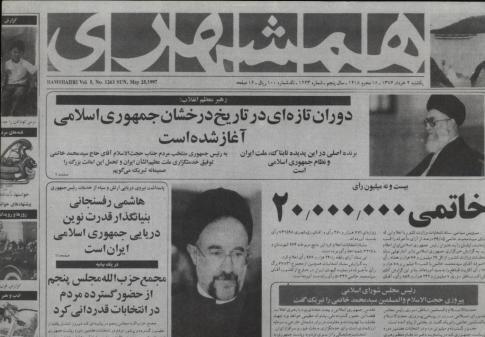
“Khatami 20,000,000.” That was the bold banner headline across Hamshahri newspaper on May 25, 1997 (4 Khordad 1376). Few of my contemporaries fail to remember it, even though many of us—including myself—were not yet old enough to cast a ballot in that historic May 23 (2nd Khordad) election. Yet our collective destiny became inextricably intertwined with that headline, setting us on a path of perpetual suspension that continues to define our lives—both for those of us who stayed and those who sought refuge in exile.
Enclosed with that day's newspaper was a portrait poster of Mohammad Khatami, framed in delicate Persian illumination and bearing the Hamshahri logo on glossy royal-octavo paper. My relationship with politics began with that insert.
My father, then 40 years old, handed me the poster alongside some money to have it framed. I tucked it away, hoping it would fade from memory. But my father was persistent. When he finally pressed me for an explanation, I retorted with youthful defiance: “I will not hang a cleric’s picture on our living room wall!” My father tried, with patient good humor, to convince his 13-year-old son that Khatami represented gradual, peaceful change, and that having a turbaned figure initiate reform might provoke fewer roadblocks from the deep state. His arguments failed to persuade a stubborn adolescent. Then my father made an unexpected move: he slipped Khatami’s portrait directly over a framed photograph of myself of identical dimensions—perhaps hoping to compel me to frame the president. It stood as an unwitting metaphor for sacrificing the child at the altar of ideology. I didn't contest his quiet act, and the poster lingered over my portrait for years. (I do not wish to portray my father as a political militant; he was merely a conscientious schoolteacher, now an aging pensioner who tracks news of negotiations and subsidies, trying to maintain his dignity far from the gaze of children who have since emigrated.)
Khatami’s presidency lasted until I turned 21. By then, as a young man, I could witness tangible cultural shifts in book publishing, cinema, and music exploring once-forbidden themes. That breathing room became starkly apparent when the conservative establishment decided on an aggressive U-turn to purge every trace of reform. Khatami’s cultural spring had unsettled the sleep of power brokers.
The reins of state were handed over to an erratic populist who ploughed through every seed of hope and progress with sheer demagoguery. Thus, the third decade of our lives was squandered under the disruptive spell of Mahmoud Ahmadinejad.
Before long, the system realized its catastrophic error in backing Ahmadinejad, discovering that those who sought to replace the legacy of 2nd Khordad with the bitter polarization of June 2009 had merely pounded water in a mortar. And our generation was too resilient to surrender. Bearing the bruises and trauma of 2009, we once again hoisted the banner of change. But by then, veteran political elites lacked the audacity to even utter the word "reform." Khatami was an unmentionable taboo confined to his home. Thus, the movement was rebranded as "Moderation"—signaling: “We are neither Khatami nor Ahmadinejad; just let us govern.” Permission was granted, but only during Hassan Rouhani’s first term. As Foreign Minister Javad Zarif’s popularity surged and anxiety grew over a potential 2021 presidential run, the JCPOA, Rouhani, and Zarif were systematically marginalized. Under Ebrahim Raisi, governance returned to absolute zero, dragging on through stagnation until a tragic turn of events brought that era to an abrupt end.
The stage was then set for Saeed Jalili—an ideologue of even narrower horizons. In the 2024 snap election, Jalili faced Pezeshkian. As passive and constrained as Pezeshkian appeared, Jalili was hyper-ideological and determined. A grim dilemma presented itself: abandon the nation to the ruinous descent of Jalili, or endure another suspended state under Pezeshkian?
We chose the latter. Yet once again, aging reformist patriarchs fell into the trap of political greed. At a time when the establishment desperately needed opposition participation to restore voter turnout, reformist leaders endorsed Pezeshkian and installed Mohammad Reza Aref as First Vice President—the blind leading the blind. Had we anticipated that Aref would be imposed while capable figures were sidelined, we would never have participated and would have joined the ranks of the boycotters without hesitation. Once again, we were outmaneuvered by our own elders.
Does the failure of reformism rest solely with the weaknesses of its leaders? In my view, no. Radical factions on both ends of the political spectrum—domestic hardliners and external maximalists operating on an all-or-nothing logic—viewed moderate reform as the greatest obstacle to their totalitarian ambitions. They waged unceasing war against it, unconcerned whether their assaults crippled Iran in the process.
Nor should we overlook another faction of critics: former insiders turned embittered opponents. These were individuals who fervently championed reform during the 1990s and 2000s, but following the brutal university crackdowns of 1999 and the 2009 Green Movement suppression, traded domestic confinement for exile abroad. Scarred and disillusioned, they evolved into fierce critics of any peaceful, internal path to change.
Through all this heartbreak, why did we persist in defending reform? Because reform represented the only viable pathway to non-violent transformation—one that sought to avoid fracturing the fragile architecture of the Iranian nation. It was a commitment to a methodology of gradual, peaceful progress rather than loyalty to individual politicians who today appear intellectually exhausted and devoid of fresh pragmatic vision.
In archaeology, there is a fundamental ethical axiom: if excavating an ancient site risks destroying its delicate relics, it is far wiser to suspend the dig and entrust the site to future generations who will possess superior tools, technology, and understanding. My conviction regarding Iran is the same. We must preserve this ancient land, with all its deep scars and structural fractures, so that future generations—equipped with knowledge, clarity, and courage beyond what we currently possess—can undertake its renewal. Even as I acknowledge that the exorbitant cost of this agonizing limbo weighs crushing upon our suspended generation, enduring patience is preferable to catastrophic destruction.
***
Today, I am 40, and my father is an aging man of 70. I remain consumed by anxiety for Iran's survival, living in chronic uncertainty, while my father waits by the satellite television for hopeful news from foreign opposition channels, quietly dismissing my critique of their sensationalism.
Though this essay began with a personal narrative, it recounts the shared biography of our generation—from protest to painful reckoning. We stand humbled between the ideological dogmatism of the generation before us and the understandable disillusionment of the generation that followed, our hands raised in exhaustion. If only the patriarchs of reform possessed the humility and courage to make their own honest confession.