The Scapegoat Reformists
A Reflection on the Political Sociology of Iranian Reforms
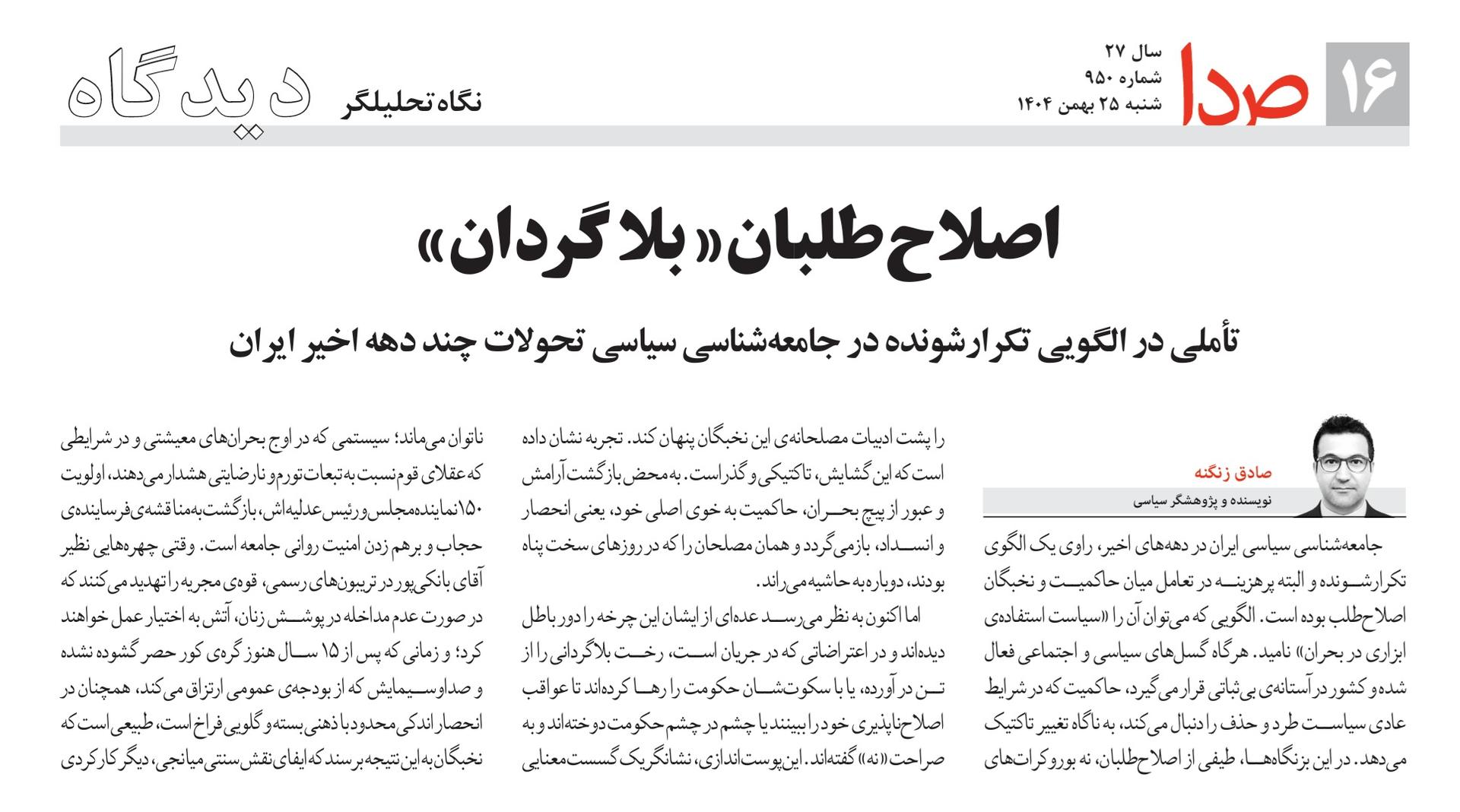
The political sociology of contemporary Iran chronicles a recurring and costly pattern in the interactions between the ruling establishment and reformist elites: a strategy that can aptly be termed "instrumental exploitation during crises." Whenever social and political fault lines rupture and the country teeters on the brink of instability, a state apparatus that routinely pursues exclusion and purges suddenly pivots its tactics. At these perilous junctures, a cadre of reformists—not opportunistic career bureaucrats, but dedicated independent thinkers, academics, and journalists bearing the deep scars of marginalization, imprisonment, and house arrest—step forward once again, driven by a profound desire to preserve Iran and avert systemic collapse.
For years, this group served as political scapegoats and shock absorbers. In moments of acute danger, they spent whatever remained of their hard-earned social capital to bridge the chasm between state and society, shielding a governing structure that fundamentally refused to recognize them. They experienced this cycle repeatedly. At each new crisis, despite clearly anticipating the state's eventual crackdown, they asked themselves: “What if Iran is harmed?” Driven by that agonizing thought, they assumed their roles as buffers, braving fierce backlash from both enraged citizens and hardline opposition.
State television, whose doors remain perpetually shut to them in normal times, briefly swings open during these flashpoints to conceal the security apparatus behind the measured, moderate rhetoric of these intellectuals. Experience has shown that this opening is purely tactical and ephemeral. As soon as calm returns and the danger recedes, the establishment reverts to its default setting—monopoly and repression—re-marginalizing the very peacemakers who offered refuge during stormy days.
Today, however, many among these elites recognize this cycle as an exercise in futility. In recent waves of unrest, they have deliberately cast off their scapegoat mantle: either stepping aside in silence to let the establishment confront the full consequences of its unyielding stance, or looking authority squarely in the eye and uttering an unequivocal "No." This metamorphosis marks a fundamental paradigm shift in elite behavior—a development I term the "Zarchi Phenomenon."
Ali Sharifi Zarchi, a professor at Sharif University of Technology, and his peers embody the transition away from the politics of scapegoating. The Zarchi Phenomenon emerges from the realization that pursuing "reforms without institutional behavioral change" is a dead end. It crystallizes when a tenured academic and state employee discards conventional caution, breaks free from the vicious cycle of "justifying the status quo to protect the homeland," and takes to platform X to confront state mismanagement with unprecedented candor. Under this new ethos, intellectuals refuse to stake their credibility on decisions they had no hand in shaping.
The roots of this realignment lie in structural deadlock and systemic disdain for sound counsel. The Zarchi Phenomenon is a direct reaction to glaring governance contradictions: a state where, in the age of artificial intelligence, a president is elected on promises to lift internet filtering yet proves entirely impotent in delivering; a system where, amid crippling economic crises and dire warnings about inflationary pressures and public outrage, the top priority of 150 parliamentarians and the judiciary chief is reigniting divisive debates over mandatory hijab and shattering public peace of mind.
When figures in official pulpits openly threaten to act as rogue vigilantes if executive branches do not crack down on women's attire; when, after 15 years, the knot of arbitrary house arrests remains unyielding; and when state broadcasting funded by the public purse remains the exclusive fiefdom of narrow minds and loud voices, it is hardly surprising that intellectuals conclude mediation serves only to prolong decay. They have realized that the real obstacle is an unyielding will—one that not only rejects structural transformation, but after decades of political maneuvering, cynically reduces national aspirations from overturning discretionary vetting (Nezarat-e Estesvabi) to merely lifting internet censorship, yet fails to resolve even that trivial demand.
History will judge which path prevailed: the state's insistence on discredited coercion, the futile sacrifices of scapegoat reformists, or the civic defiance of the Zarchis. What is undeniably clear is that persisting with the current trajectory and extinguishing all avenues for genuine, guaranteed structural reform will merely replicate the "Zarchi Phenomenon" and strip away the final layer of intellectual support for stability. It remains to be seen whether the system will submit to deep structural remedies or continue down the path that alienates its most sincere advocates and transforms them into standard-bearers of civic resistance.